Dhara II

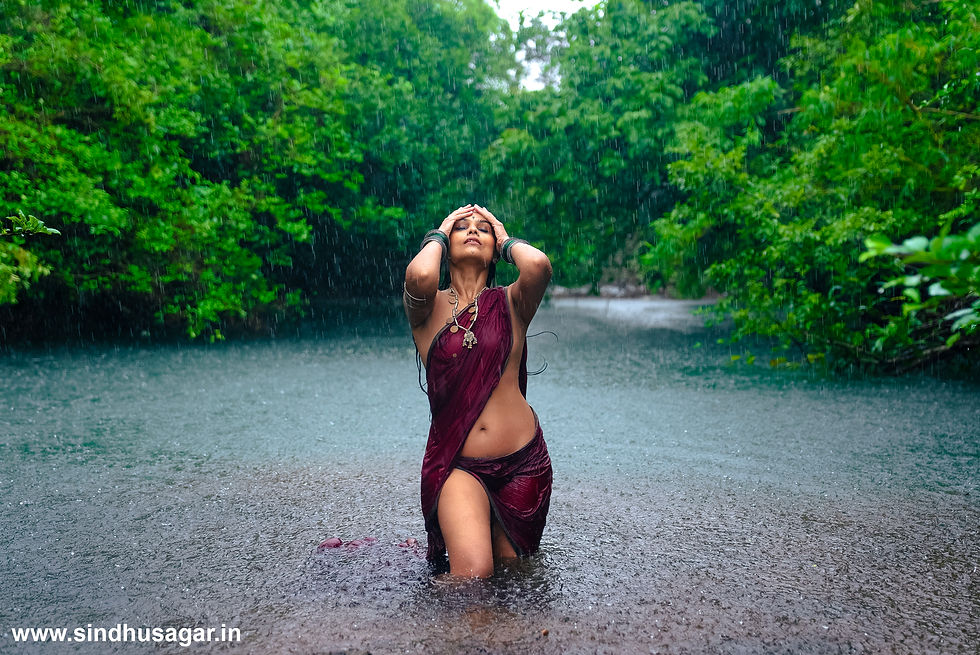
धारापातजले मग्ना सा वनान्ते वराङ्गना ।सिक्तकेशकलापेन मेघश्रीरिव शोभते ॥
Immersed beneath the falling waters,the beautiful woman stands within the forest;with her tresses drenched and flowing,she shines like the splendour of a rain cloud.

She comes to the waterfall the way water comes to itself on impulse, remembering its own nature. The nine-yard saree moves with her the same way. That white cloth hasn't yet remembered its cloth. I sometimes think they must both believe they're the river.
She stands where the fall breaks into mist, and the mist touches all of her, evenly the way old devotion touches a name repeated too many times to still mean only one person.
The saree darkens first at the shoulder. Then the fabric forgets its own weight and becomes a second skin, a first skin, no skin at all just the idea of covering, kept only as a memory of covering. Through it, the light moves the way it moves through morning smoke rising off a rooftop. Light doesn't distinguish between a wall, smoke, or water it paints whatever comes its way. The water, the wet fabric, is simply canvas. And her body becomes the painting on the dark rock that holds the water, and holds her.
She dances for herself there, immersed in the cool shower coming straight from the forest's womb, the dark, green, dense trees giving way to water pristine and ferocious enough to smoothen rock in its path. It falls over her and she dances with it, meeting the source that first made her alive.

I watch her and ask myself: haven't I felt the same thing underwater? Haven't I forgotten, carelessly, whether I was clothed or not? And if another human, made of the same elements, feels that and it moves her body this way, who am I to judge the movement, or the dress? If there's an apology owed, it's owed to the nature that made both of us. Why is one body ordinary and another vulgar, when every pore of us still calls out for the ocean, the wind, the fire we came from and will return to?
But watching her, I feel less like a man watching a woman than someone who's stumbled on a forest nymph mid-ritual, a goddess taking her hour in a pristine place. Her hair spreads on the water like a question nobody needs answered. Her hips remember something older than choreography. Somewhere in the pull of her waist is Kālidāsa's swan walking woman, though she's never read him and doesn't need to.
She dances, and the dance isn't for anyone watching. Her arms find the shapes water already makes when it falls the same arc, the same give, the same refusal to land twice in the same place.

Then she stops. Lies back into the shallow pool where the fall lands, and the paradox settles into her without asking permission. The body that was dancing a moment ago is now perfectly still, eyes closed, chest rising in a rhythm the waterfall seems to keep time to. Fire, banked. Water, patient. Both at once the way a single note can carry two harmonics without breaking apart.
This is the part where the camera almost apologizes for being there. She isn't performing surrender; she has actually surrendered, and there's a difference the lens can tell even when the viewer can't say how. Her breath slows to the fall's rhythm. Her open palm floats, fingers loose the most unguarded thing in the frame.
Wet cloth clings the way memory clings not to hide, not to reveal, just because it has nowhere else to go. What the eye finds isn't nakedness. It's the weather. It's the oldest fact there is: a body remembering it's made of the same five elements as the fall it's lying in.
She opens her eyes. Looks past the lens, past me, at something in the canopy only she can see. And in that look is the whole paradox, finally at rest sensual without hurry, meditative without distance. A Nāyikā who needs no saree to be dressed in grace, and no stillness to be dancing.

The fall keeps falling. It doesn't need her to mean anything. It fell this way before either of us arrived, and it will fall this way after. She simply let it, for an afternoon, fall through her unboxing, untold how to move or look, her being as old as water, as fire, as earth and sky. The five elements call, and she listens the way you listen to whatever is deepest in you, beneath the rules that teach us to control thought, behaviour, dress, expression. Nature is the floor beneath all of it, and given half a chance, desire always finds its way back to the surface.
Clad in her saree again, she could be any woman soft, ordinary, unremarkable.
But the energy still moving through her eyes is the same energy of the water she was just bathing in. The questions in my mind go quiet. Through the camera, art takes its shape. Her presence becomes art, and I simply happen to be there to catch it.
To access full photo essay subscribe to www.patreon.com/raginee
Muse : K Raginee Yogesh
Words & Images : Yogesh Kardile
By accessing this content, you agree to not download, screenshot, redistribute, repost, alter, illustrate, paint, trace, use as reference, manipulate, or share it in any form publicly or privately without my prior, written permission.
This includes:
No AI training or replication
No use in mood boards, NFTs, edits, or fan art
No sharing via messaging apps or forums
No re-uploads on social media or other platforms
No sketches, derivative illustrations, or studies based on this work
This space is sacred. Violations will lead to an immediate ban and legal action if needed. Thank you for respecting the spirit and sanctity of this intimate creative space.


Comments