HEERA : The Forest Maiden

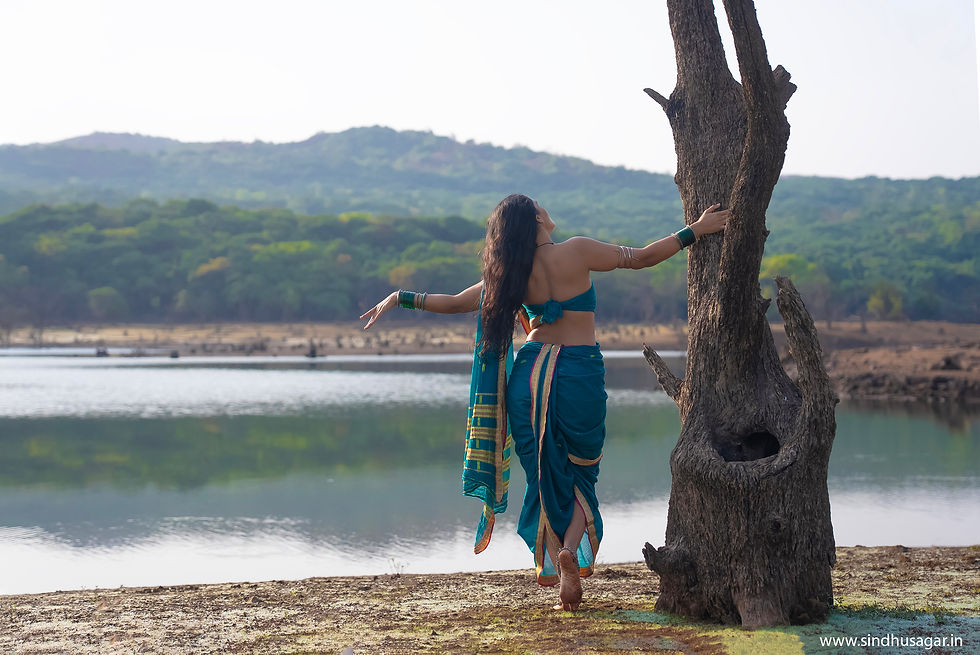
Heera the forest maiden by the lake is an epitome of Shringara and Veer rasa both at once, a rarity that the classical treatises describe but rarely embody in a single living form. She is nurtured not by instruction or cultivation, but by nature herself showered by rain, scorched by the blazing eye of the sun, her skin holding the memory of every season she has passed through. Her feet have trodden paths that have no name on any map, paths that wind between ancient trees and disappear into the green dark.
She is the one who invokes desire and fear simultaneously not because she intends to, but because she is. She carries that original feminine power which precedes all refinement, all codification, all the elaborate grammar of the Kama Sutra's nayikas. The Kama Sutra imagines women as types to be understood and approached. Heera is not a type. She is a fact of nature as ungovernable as the river's sudden flood, as inevitable as the turning of the season. She is nature's child; a true gem. A free spirit of the forest, born into the wilderness and living the entirety of her life inside the small hamlet within the dense forest.
The ancient Maharashtrian Prakrit treasury of rural women's desire knows her. One of its verses whispers:
"Even as she lifts the water-pot to her head, her waist bends like a vine in the wind. O traveller, why do you hurry? Stay a little. The road can wait."
-Gatha Saptashati
She is not the nayika of perfumed chambers. She is closer to the poetry of a couplet immediate, unadorned and devastating.Someone who doesn't mind disappearing into the ripple of water or rising on wind like a bird's feather has already made her peace with impermanence. She chose to be unsung, but makes sure to live life fully on her own terms.
Her ways are unknown to the city-bred folks and artists who imagine wildness from a comfortable distance. Perhaps someone has glimpsed her in her element through the lattice of trees, through the shimmer of heat rising off the forest floor. But she is a butterfly that no one can catch. Treading the forest paths with the enthusiasm of a child, resting under the trees like a damsel, bathing in the lake like a fairy dazzling skin and supple body, water holding her as tenderly as the earth does.

The water flows down her curves like pearls descending into a sacred pond. The movement of her hands captivates my heart. There is a grammar in those gestures that no school of classical dance ever codified, because it was never meant to be performed. It simply is. And when she locks her sight into my eyes, it is like an arrow of Kama Deva piercing clean through the chest, leaving no wound that can be dressed, only a longing that deepens with every breath.
People say: do not fall prey to her magic. But what can I do? The raging blood in my veins, and the honest hunger of my age, drags me toward her the way the moon drags the tide without argument, without apology. She is the strong, rustic, primal feminine force. As old as the first female on this earth. She knows my longing truly. She has known others' longing too, and she holds all of it without flinching, the way the river holds the rain.
"She did not glance at me even once. Yet the moment she passed, my chest tightened like a bowstring drawn to its full length. What did she do? Nothing. What did she undo? Everything."
-Gatha Saptashati
This is the original literature of that feeling. Not metaphysics, not philosophy, just the raw truth of a body moved by another body, consecrated by the poet into something that outlasts both of them. Something that is universal and can be felt even in the future until we have the spirit that is connected with nature.

For me she is as pure as the river in its first morning hour. She is as strong as the tigress who moves through the forest with complete authority over her ground. Her green saree draped around her body looks like the green Shringara donned by the earth itself at the first rain of monsoon, that electric, almost unbearable freshness. Her walk resembles the breathing of the earth: unhurried, total, happening because it must.
The motion of her bosom with each breath is like the moving forest on the rolling hills alive, rhythmic, indifferent to the watching eye and yet impossible to look away from. People say you must find purpose in life, as though purpose were a destination, a certificate, an arrival. But I ask them: what isthe purpose of life? Is it not this to be so moved by another being that the separation between you and the world dissolves? Isn't being one with your soulmate the oldest answer the species has ever given to that question? Are we not made for each other, in the way rain is made for the earth, in the way light is made for the eye?
And here the Gatha Saptashatī offers its quiet, devastating answer not in argument but in image:
"The crane stands one-legged in the river. The lotus sleeps on the water. And she she simply stands at the doorway, watching the road. That is all. And that is everything."
The purpose is not explained in this verse. It is simply shown. Heera understands this without having been taught it.Don't you see that the animals live together, raise their offspring, grieve their losses, and one day return quietly into the earth without ceremony or regret? Don't you observe their bond and their love not dressed in the language of romance, but enacted entirely in presence, in proximity, in the shared warmth of the body? I am no different from any other being on this earth. We share the same earth, the same water, the same air, the same forest, the same original dark from which all life emerged blinking and bewildered.

I feel she is made for me and I for her not by fate written in some distant heaven, but by the simple fact that two beings, forged from the same soil, recognise each other across the distance of a forest path. Heera is the one who has never forgotten her roots, her true identity that stretches back to the first female, the Mother Goddess, who created the world through her womb, who held chaos in her body and turned it, with her own heat and her own darkness, into life. Heera carries that memory in her blood. It has never left her. She is not a symbol of the ancient feminine she is, still walking, still breathing, still meeting your eyes across the water with the full, unhurried power of the very first morning.

Muse : K Raginee Yogesh
Words & Images : Yogesh Kardile
By accessing this content, you agree to not download, screenshot, redistribute, repost, alter, illustrate, paint, trace, use as reference, manipulate, or share it in any form publicly or privately without my prior, written permission.
This includes:
No AI training or replication
No use in mood boards, NFTs, edits, or fan art
No sharing via messaging apps or forums
No re-uploads on social media or other platforms
No sketches, derivative illustrations, or studies based on this work
This space is sacred. Violations will lead to an immediate ban and legal action if needed. Thank you for respecting the spirit and sanctity of this intimate creative space. 🙏🏽


awesome